Can You Keep Ring Engraving a Surprise From Your Partner?
Yes—you can keep a ring engraving a surprise from your partner. The better question is whether the surprise will feel thoughtful once they discover it, and whether you can keep the secret without risking a spelling mistake, an uncomfortable message, or a ring that needs to be remade.
After years around bridal accessories and ateliers, I’ve seen how much meaning a few words can carry. I’ve also seen couples discover that the most romantic-looking font is hard to read, or that a band feels lovely on the jeweler’s display but pinches between the fingers. Engraving is personal, but it still has to work in real life.
Here’s how to plan a surprise engraving that feels intimate, fits your partner, and leaves room for the two of you to make your own traditions.
Is a Surprise Engraving a Good Idea?
A private message inside a ring can be a beautiful counterpoint to the proposal. The outside may be seen by everyone; the words inside belong to the wearer. That contrast is colored gemstone engagement ring part of the appeal of a private message ring: it can hold a date, a phrase you share, a reference to a beloved place, or a few words that make sense only to you.. Pretty simple.
It’s a good surprise when you have a strong sense of your partner’s taste and when the message is affectionate without making assumptions about what they want their ring to say. It may be less suitable if your partner likes to approve every detail, has particular language preferences, or has expressed a wish to choose their ring together. Surprise should feel like care, not like a decision made on someone else’s behalf.
There’s no rule that says every ring has to be chosen, engraved, and presented in one grand reveal. You can propose with a ring that’s complete except for the inscription, then plan the engraving together. Or you can surprise them with the message while leaving other choices—such as the wedding band or a later resizing—to be shared. Romance and collaboration are not opposites.
Breaking Engagement Ring Traditions
Couples are increasingly treating engagement rings as personal objects rather than a checklist of inherited rules. That can mean choosing a low-profile setting Find out more instead of a tall solitaire, wearing a ring on a different finger, selecting a colored stone, or skipping a conventional proposal script altogether. Engraving fits naturally into that shift: the words can be as traditional, playful, understated, or unusual as the couple.
Some people want a classic date. Others prefer a line from a poem, a nickname, a small symbol, or a phrase from their shared life. There is no requirement to put a proposal date inside the ring, and there’s no need to make the inscription sound formal to make it meaningful. A short, specific phrase often feels more personal than a grand declaration chosen because it seems “bridal.”
One practical way to begin is by making a private Pinterest board for ring inspiration. Save images of settings, metal colors, engraving styles, and details you think your partner might like. Look for patterns across the board: Are the rings low-profile? Minimal? Sculptural? Do you keep saving colored stones or plain metal bands? Inspiration is useful, but it’s not a substitute for knowing what feels comfortable on the hand.
Modern Settings and Silhouettes: Leave Room for the Message
Engraving isn’t only about the words. I remember a project where wished they had known this beforehand.. The ring’s shape, width, metal, and setting affect whether there’s space for an inscription and how comfortable it is to wear. A slim band may have room for only a few characters. A contoured or heavily detailed band may have limited uninterrupted space. Some designs can be engraved only in certain areas, so ask the jeweler before treating a message as a guaranteed feature.
Modern settings can change how a ring feels and behaves. A low-profile design may be easier for someone who wears gloves or works with their hands. A bezel setting, which surrounds the stone with a rim of metal, can have a sleek outline and fewer exposed edges than some prong settings. A sculptural or asymmetrical silhouette may feel distinctly individual, though it can make future band pairing more specific.
I keep a running mental list of settings that snag on knits. Prongs and raised details deserve a gentle fabric test if your partner wears sweaters or delicate clothing often. And please ask how the band feels between the fingers. A ring can look perfect from above and still feel too wide, sharp-edged, or crowded when worn beside another band.
If you’re shopping with customization in mind, brands and retailers such as Lily Arkwright may be one place to explore different design directions, while Modern Gents offers another point of comparison for people looking at more accessible ring options. The important thing is not the label; it’s checking what each specific ring can accommodate. Ask about engraving availability, character limits, resizing, return terms, and the materials used for the exact design you’re considering.
Colored Gemstones as Storytelling
A gemstone can carry meaning without relying on a traditional diamond or a familiar color palette. A deep blue stone might remind you of a coastline you visited together; a green gem could recall a garden, a family connection, or simply your partner’s favorite color. The story can be known only to the two of you—or not be a story at all. Liking the stone is reason enough.
Engraving and color can work together without competing. For instance, you might choose a stone with personal significance and keep the inscription very simple: a date, initials, or two words. If the gemstone already tells a story, the inside message doesn’t need to explain it. Conversely, a plain metal band can make a private phrase feel like the central detail.
Do ask clear questions about a gemstone’s care and suitability for daily wear. Different stones vary in durability and may need different handling, cleaning, or protection. Ask the jeweler what to expect before deciding, especially if your partner plans to wear the ring every day. A romantic choice should also be a well-informed one.
Bespoke Ring Design and Customization
A bespoke ring gives you more control over the details, but it also gives you more decisions to make. You may be able to discuss the silhouette, stone, metal, finish, and engraving as part of one design process. That can be helpful if the inscription needs a particular placement or if the ring’s shape is unusual. It also means you should confirm every detail in writing before production begins.

At a bridal inspiration outlet such as Bespoke Bride, you may find ideas for personalizing the broader wedding experience. For a ring itself, use any inspiration as a starting point for a direct conversation with the jeweler or maker. Share the words you’re considering, ask to see a mock-up or proof, and clarify what happens if the finished engraving differs from what you approved.
Customization is not automatically better than a ready-made design. Bespoke work can involve longer timelines, added costs, and fewer options for returns or exchanges. If you’re planning a proposal date, build in time for design approval, production, delivery, and possible adjustments. A surprise is less fun when it depends on a rushed inscription arriving the day before you leave town.
How to Keep the Engraving Secret Without Making It Risky
- Choose a message that is unmistakably yours. Keep it personal, kind, and short enough to fit. Avoid a joke that could land badly later or a phrase that depends on a temporary in-joke your partner might not want to wear forever.
- Check spelling, punctuation, and dates twice. Copy the text into a note and read it slowly. If the message includes a date, confirm the format and make sure it won’t be confused across countries or cultures.
- Ask the jeweler about the exact ring. Confirm the placement, character limit, font options, and whether the inscription affects resizing or return eligibility. Ask for a proof where available.
- Keep a discreet record. Save the final approved wording and order details somewhere private. A password-protected note is more reliable than a half-remembered conversation.
- Protect your partner’s preferences. If you’re unsure whether they’d welcome a surprise, choose a provisional ring or propose without engraving, then decide on the message together.
For wedding planning, the same low-drama organization helps. You could keep a private planning document for ring details and use a separate Google Sheet for RSVPs to track guest responses. If you’re sharing an invitations promo, mention the sheet as a simple planning companion—for example, “Use our invitations promo to get started, then keep your guest replies organized in a Google Sheet.” Just don’t put the secret ring message in a document your partner can casually open.
What Should You Engrave?
The strongest inscriptions tend to sound like the couple, not like a greeting card. Consider these starting points:
- A date: The proposal, first meeting, or another moment that matters to both of you.
- A short phrase: Something you genuinely say to each other, rather than a line chosen because it sounds romantic in isolation.
- A place: Coordinates or a place name connected to your shared history, if your partner would enjoy that kind of reference.
- A symbol or initials: A quiet option when the band has limited space or your partner prefers minimal details.
- A future-facing message: A few words about choosing one another, without turning the ring into a promise your partner hasn’t agreed to make.
Before committing, imagine the message being read years from now. Does it still feel warm and true? Is it something your partner would be comfortable wearing, even if they show the ring to someone else? An inscription can be private, but it doesn’t have to be secretive or overly intimate.
Make Space for the Wedding Band Exchange
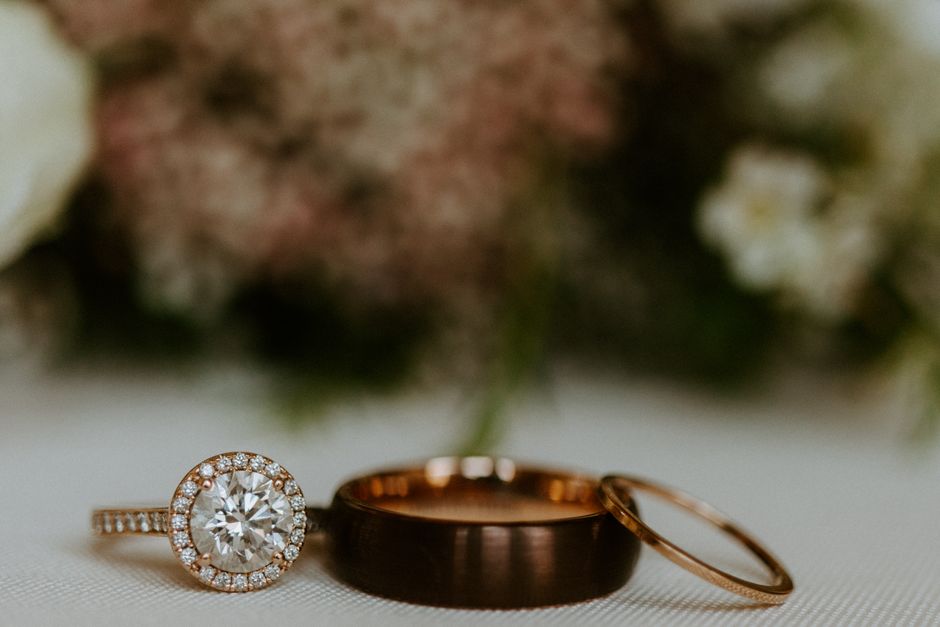
An engagement ring doesn’t need to solve every jewelry decision at once. The later wedding band exchange can be another chance to choose something together: a matching band, a contrasting metal, a contour that sits neatly beside the engagement ring, or a simple band that stands on its own. If you’re planning to wear both rings on the same finger, ask to try them together or discuss how their shapes will sit side by side.
Also consider whether the inscription should go on the engagement ring or the wedding band. A wedding band may offer more room, but that depends on its width and design. Some couples keep the engagement ring unengraved and put the private message on the band exchanged during the ceremony. Others engrave both. Neither choice is more meaningful by default.
So, Can You Keep It a Surprise?
Absolutely. A surprise engraving can be a lovely way to make an engagement ring feel unmistakably personal, especially when the message reflects something you already know your partner values. The secret itself is not the measure of romance; the thought behind it is.
Ask yourself this: choose a ring that fits their style and daily life, ask practical questions about the setting and inscription, and don’t let the excitement rush you past the details. If your partner would rather be involved, leave room for that. You can still make the moment special—and the eventual wedding band exchange can become its own meaningful chapter.
The best private message ring is not the one with the most poetic words. It’s the one your partner is glad to wear, comfortable between the fingers, and happy to discover is yours together.